
Lost Treasures of the 45‑78 RPM Records


Your front-row seat to retro music events, legendary artist birthdays, tributes, and timeless rock 'n' roll stories powered by our cutting-edge AI DJs.
At Gold Star Oldies USA, we live and breathe the best eras in music history. We spin the greatest hits from mid-sixties vocal groups through the high-energy seventies and eighties rock anthems. Our happenings page is where our community gathers to look back at the moments and melodies that shaped generations.


.
October 23, 1954 — Elvis Presley's second Sun single, "Blue Moon Of Kentucky," breaks out in Nashville and New Orleans, becoming his first chart hit outside of his native Memphis.
October 24, 1942 — Louis Jordan ushers in a new era in music when he enters the charts with his innovative and irreverent debut disc "I'm Gonna Leave You On The Outskirts of Town," reaching #3 R&B. As the father of rhythm and blues, he would go on to have 56 more hits in only nine years, influencing many rock and roll stars, including Chuck Berry, whose "Johnny B Goode" opening guitar riff is borrowed from the 1946 Jordan recording "Ain't That Just Like A Woman."
1979 — The Guinness Book of World Records names Paul McCartney the best-selling songwriter in the history of recorded music, having composed 43 platinum songs and sold over 100 million records.
October 25, 1961 — Mick Jagger and Keith Richards, who haven't seen each other since primary school, run into each other at the Dartford train station in England. Keith is on his way to Sidcup Art College; Mick is headed to the London School of Economics. Noticing the Muddy Waters and Chuck Berry albums Mick is carrying, Keith strikes up a conversation.
1995 — Cliff Richard (nee Harry Webb), is invested as Sir Cliff Richard, becoming the first pop star to receive a knighthood. In the ceremony, Queen Elizabeth thanks him for his contributions to charity and music.
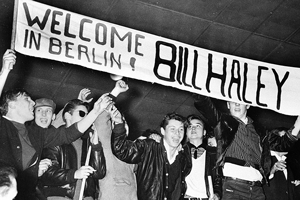
October 26, 1958 — Germany's first rock concert is held in Berlin and ends in a riot as teens from the eastern and western sectors of the city skirmish during a performance by Bill Haley and His Comets. By the time police clear the concert, five policemen and six audience members are seriously injured. East Germany's official Communist newspaper denounces Haley in a front-page editorial for "turning the youth of the land of Bach and Beethoven into raging beasts."
October 28, 1958 — Buddy Holly (center) makes his last major television appearance, lip-syncing on ABC's American Bandstand to "It's So Easy" and "Heartbeat" just months before the plane crash that ends his life. It is also his final performance with Crickets Jerry Allison (top) and Joe Mauldin (bottom) before he splits with their producer, Norman Petty, and moves to New York while they stay in Texas. Holly assembles a new group for his ill-fated tour, but Allison and Mauldin have hopes to get back with Buddy after the tour ends.
Sources:
Eight Days a Week (Ron Smith)
Eight Days a Week (Kenneth Best)
On This Day in Black Music History (Jay Warner)
Chronology of American Popular Music, 1900-2000 (Frank Hoffman)
calendar.songfacts.com
onthisday.com/music
Gospel great Mahalia Jackson in 1911
Sax man Charlie Barnet in 1913
Guitarist Al Casey (Duane Eddy’s Rebels / Wrecking Crew) in 1936
Mike Piano of the Sandpipers in 1944
Herman's Hermits guitarist Keith Hopwood in 1946
Parliament/Funkadelic/James Brown bassist Bootsy Collins in 1951
:
Wilbert Harrison (“Kansas City”, “Let's Work Together”) in 1994
Actor/songwriter Hoyt Axton (“Joy to the World”) in 1999
John King, American rock drummer (Steve Miller Band, 1972-74) in 2010
Unifics lead singer Al Jackson (“Court of Love”) in 2013
Stuart Edwards, British guitarist (Edison Lighthouse - "Love Grows Where My Rosemary Goes") in 2016
Cherry Slush bassist Art Hauffe (“I Cannot Stop You”) in 2018
Paul Berrere of Little Feat in 2019
Stan Kesler, American session musician (Sun Studios- Jerry Lee Lewis, Carl Perkins, Roy Orbison), songwriter ("I'm Left, You're Right, She's Gone”, "I Forgot to Remember to Forget"), and record producer (Sam the Sham and the Pharaohs -"Wooly Bully") in 2020
Jack DeJohnette, American Jazz drummer (Miles Davis; Ron Carter; Skyline) in 2025
Oct 19, 2026 10:00 AM
Sep 27, 2026 11:30 AM
🎉 October 7, 1952 — Happy Birthday to Bandstand! 🎉

From sixties harmony groups to the powerhouse rock bands of the seventies and eighties, we pay tribute to the performers who gave us timeless soundtracks. Check out our photo spotlight celebrating classic recording artists.


